
 Follow on X
As Casualties Mount, Questions Grow Over America’s Strategy in Iran
With four American service members killed in recent days, escalating attacks on U.S. bases, and growing public opposition to the conflict, the war with Iran is entering a more dangerous phase while fundamental questions about Washington’s long term strategy remain unanswered.
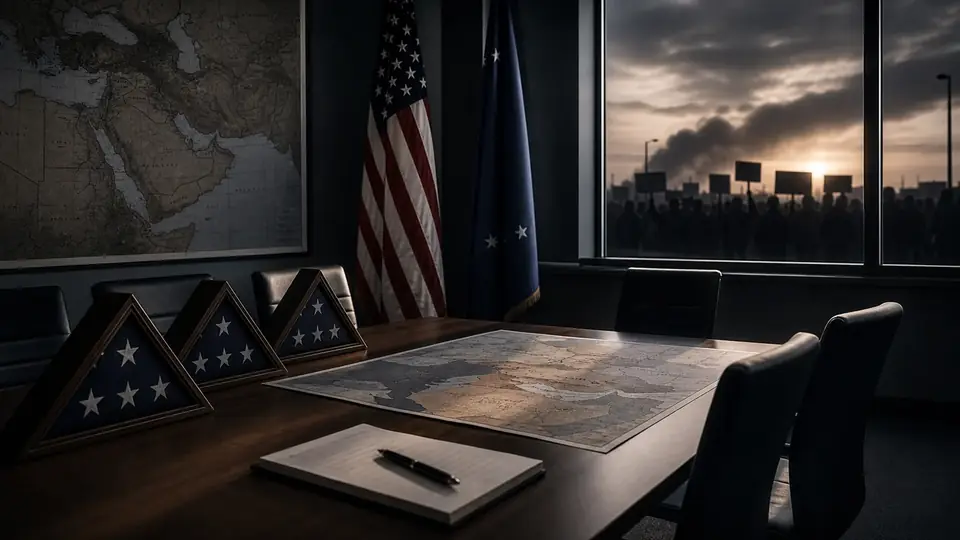
The war between the United States and Iran continues to intensify, with new American casualties, expanding attacks on U.S. military installations, and increasing debate over whether the conflict has a clearly defined objective.
This week, the Pentagon confirmed the death of a third American service member from last week’s attack on a U.S. base in Jordan.
Sergeant Angel Rampersad, 28, of New York, had initially been listed as missing. He is now presumed dead.
His death brings the total from that single attack to three American fatalities.
Combined with another U.S. service member killed days earlier in Iraq during the controlled detonation of an Iranian drone, four American troops have died within just a matter of days.
According to Defense Department figures, the total number of U.S. military personnel killed since the conflict escalated in February now stands at 18.
A president under pressure
President Donald Trump traveled to Dover Air Force Base to honor the fallen as their remains returned to the United States.
While there, reporters asked whether Iran had intentionally targeted barracks where American troops were sleeping during the attack in Jordan.
Trump responded simply, “I don’t know,” before adding that Iran would “pay a big price” and was being “decimated.”
The exchange left unanswered one of the central questions surrounding the attack: whether the strike specifically targeted sleeping service members.
The president also disputed polling suggesting that a majority of Americans oppose continuing the war, arguing instead that voters are primarily concerned about gasoline prices.
Public polling, however, has consistently shown broad public support for bringing the conflict to an end rather than expanding military operations.
Why Jordan has become a critical battlefield
Jordan has emerged as one of the most strategically significant fronts in the conflict.
The country hosts several important U.S. military installations, including Muwaffaq Salti Air Base, where American and allied forces help intercept missiles and drones traveling toward Israel.
Military analysts note that repeated Iranian attacks on Jordan appear focused on degrading regional air defense capabilities rather than simply launching indiscriminate strikes.
According to those assessments, Iran has increasingly targeted interceptor systems, air defense infrastructure, and military facilities that support America’s long term ability to project power throughout the region.
By contrast, U.S. Central Command has described American strikes as targeting military operations centers, logistics infrastructure, and maritime assets inside Iran.
The differing approaches have prompted debate over which strategy may prove more sustainable if the conflict continues.
Growing concerns about America’s regional posture
Retired Army Colonel Douglas Macgregor has argued that the expanding conflict highlights the vulnerability of America’s network of military bases across the Middle East.
As attacks continue against U.S. installations, questions are growing about whether maintaining dispersed military forces throughout the region has become increasingly difficult and dangerous.
Jordan’s experience illustrates how quickly those installations can become direct targets during a wider regional conflict.
A new price tag for the war
As the military campaign expands, so too does its financial cost.
During testimony on Capitol Hill, Defense Secretary Pete Hegseth requested approximately $1.5 trillion in defense funding, arguing that the current conflict differs fundamentally from previous U.S. wars in the Middle East.
Hegseth stated that this was “not one of the stupid, pointless Middle East wars.”
The remark acknowledged widespread criticism of earlier military interventions while simultaneously arguing that the current conflict serves a different strategic purpose.
Critics, however, argue that administration officials have yet to clearly explain exactly what makes this war different or what conditions would define success.
The unresolved question of strategy
One issue continues to dominate the debate.
What is the endgame?
Administration officials have repeatedly stated that preventing Iran from obtaining a nuclear weapon remains a central objective.
Secretary of State Marco Rubio has argued that Iran cannot be allowed to develop the conventional military protection necessary to pursue a nuclear weapons program.
At the same time, many public assessments before the current conflict concluded that Iran was not actively building a nuclear weapon, although concerns remained over its expanding nuclear capabilities and uranium enrichment activities.
Whether the current military campaign ultimately reduces or increases Iran’s long term nuclear ambitions remains a subject of ongoing debate among security analysts.
An economic source of leverage
Beyond military operations, another dimension of the conflict is drawing increasing attention.
Iran’s geographic position gives it influence over the Strait of Hormuz, one of the world’s most important energy shipping corridors.
Roughly one fifth of global oil supplies move through the narrow waterway.
Any disruption to commercial shipping has immediate consequences for global energy markets, insurance costs, and international trade.
Some analysts have described this leverage as one of Iran’s strongest strategic advantages, arguing that it allows Tehran to impose significant economic pressure without possessing a nuclear weapon.
Every attack on commercial shipping or disruption in maritime traffic reinforces the strategic importance of the strait and highlights the broader economic risks associated with a prolonged conflict.
A conflict with no clearly defined conclusion
As casualties continue to rise, public skepticism grows, and military operations expand across the region, one question remains largely unanswered.
What would bring this war to an end?
The administration continues to emphasize military pressure on Iran, while Iran has shown no indication that it intends to abandon its regional strategy in response to continued strikes.
With no publicly articulated roadmap for deescalation and no widely defined conditions for victory, the conflict appears increasingly likely to become another prolonged confrontation whose costs continue to mount long before its outcome becomes clear.