
 Follow on X
Your WiFi May Soon Know More About You Than You Do
New sensing technologies promise everything from hands free automation to health monitoring. But privacy advocates warn they could also transform everyday devices into powerful tools for continuous surveillance.
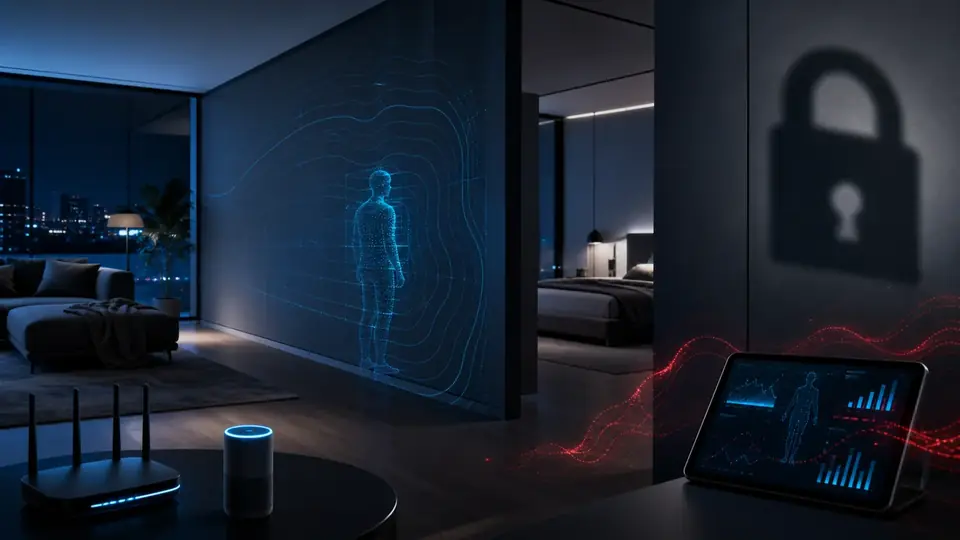
For years, privacy debates have centered on smartphones, social media platforms, and internet browsers.
Now, attention is turning toward a new generation of technologies capable of monitoring people through the devices already sitting in their homes.
From infrared facial sensing to WiFi based motion detection, researchers and technology companies are developing systems that can measure breathing, heart rate, movement, and even subtle facial activity without requiring wearable devices.
Supporters see enormous potential for healthcare, accessibility, and smart homes.
Critics see something else entirely.
Apple’s latest acquisition raises new questions
Earlier this year, Apple acquired Israeli startup Q AI, a company reportedly valued at approximately $1.6 billion despite having not yet released a commercial product.
The company is led by Aviad Maizels, founder of PrimeSense, the firm whose technology became the foundation for Apple’s Face ID system.
Apple has not publicly detailed how it plans to use Q AI’s technology.
However, patent filings associated with the company describe systems capable of analyzing facial skin micromovements using infrared light.
According to the patent, the technology could potentially detect words mouthed silently or spoken too quietly for conventional microphones to capture. It also describes measuring physiological signals such as heart rate, breathing patterns, stress levels, and emotional responses through subtle changes in facial movement.
Notably, Face ID already relies on infrared illumination to authenticate users, although there is no public evidence that current iPhones perform the broader health and behavioral analysis described in Q AI’s patent filings.
The technology extends beyond smartphones
The growing interest in passive sensing is not limited to Apple.
Several technology companies are investing in what has become known as WiFi sensing.
Rather than relying on cameras or microphones, WiFi sensing analyzes how radio waves emitted by a wireless router change as they bounce off people and objects moving through a room.
Those changes allow software to estimate movement, location, and in some cases even extremely small motions such as breathing or chest movement associated with heartbeats.
The underlying technology, known as IEEE 802.11bf, was approved as a WiFi sensing standard after years of research dating back to the early 2000s.
Developers say the technology could improve home automation, fall detection for elderly individuals, energy efficiency, and security systems without requiring cameras throughout a home.
Privacy concerns are growing
The same capabilities that make WiFi sensing attractive for consumer convenience have also raised significant privacy concerns.
Unlike cameras, WiFi sensing does not require a direct visual line of sight.
Instead, it analyzes radio wave reflections to estimate movement within a building.
Researchers have demonstrated that these systems can distinguish between different types of motion, including walking, hand gestures, breathing, and occupancy.
As the technology continues to improve, privacy advocates worry that consumers may not fully understand the extent of data being collected by connected devices already operating inside their homes.
Could different AI systems eventually work together?
Some technology critics have raised broader concerns about how multiple artificial intelligence systems could eventually interact.
They point to a future in which smartphones monitor biometric signals, home WiFi networks detect movement throughout a residence, wearable devices continuously track health data, and connected vehicles evaluate driver behavior.
At present, there is no public evidence that these systems are integrated in the manner critics describe.
However, some observers argue that the rapid growth of artificial intelligence makes it important to consider how increasingly interconnected technologies could affect privacy, autonomy, and personal freedom if deployed without meaningful safeguards.
Others counter that such scenarios remain speculative and that existing products are designed for far narrower purposes, such as authentication, home automation, or health monitoring.
The debate is no longer about possibility
What is no longer speculative is the underlying technology itself.
WiFi sensing exists.
Infrared biometric sensing exists.
Artificial intelligence capable of interpreting physiological signals continues to improve rapidly.
The larger question is no longer whether these technologies can monitor aspects of human behavior.
It is who controls that information, how it will be used, what limits will govern its collection, and whether consumers will have meaningful choices about participating.
As sensing technologies become embedded in phones, routers, vehicles, and other connected devices, the debate over privacy is shifting from the internet itself to the physical spaces where people live their daily lives.
For supporters, these advances promise smarter homes, improved healthcare, and greater convenience.
For critics, they represent another step toward a world in which technology is capable of observing not only what people do, but how they feel, how they move, and potentially how they react, all without them ever realizing it.