
 Follow on X
Democrats Want to Win Back Men. Is the Problem Really Masculinity?
A new Atlantic article argues Democrats need to reconnect with working class men. But the larger debate may not be about masculinity at all. It may be about whether voters believe the party’s message matches its actions.
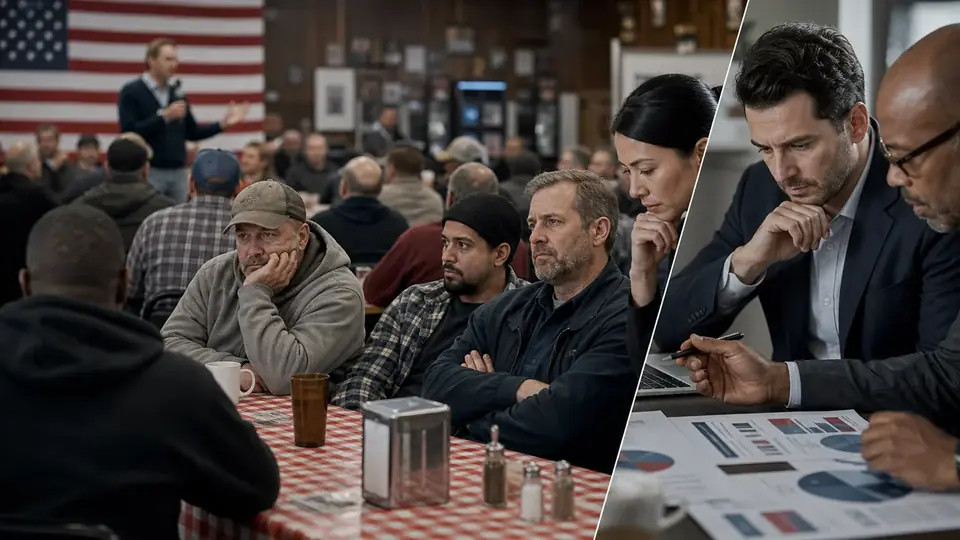
A new article from The Atlantic explores a question Democrats have been wrestling with since the last election.
Why are so many men no longer voting for the party?
The article follows Ohio congressional candidate Brian Poindexter, a union ironworker who drives a pickup truck, built his own shed, and openly embraces traditionally masculine interests. His argument is that Democrats have spent too much time appealing to what he describes as the party’s “softer side” and need to become more comfortable embracing masculinity.
The premise reflects a growing conversation inside Democratic circles.
But it also raises a larger question.
Is the party facing a masculinity problem, or a credibility problem?
Can Image Change Voters’ Minds?
Much of the discussion surrounding Democratic outreach to men has focused on presentation.
Find candidates who hunt.
Find candidates who drive pickup trucks.
Find candidates who wear work boots instead of suits.
The assumption is that the right messenger can reconnect the party with working class male voters.
Critics argue that approach mistakes appearance for substance.
Changing the image of a candidate does not necessarily change how voters view the party’s priorities.
If voters believe the policies remain unchanged, simply changing the packaging may do little to alter public perception.
The Messenger or the Message?
Democrats have promoted a wide range of national figures as voices capable of broadening the party’s appeal.
Pete Buttigieg.
Gavin Newsom.
Josh Shapiro.
Tim Walz.
Each has a different background, governing style, and political identity.
Yet critics argue they all represent the same broader strategy: finding the right spokesperson rather than rethinking the policies themselves.
Whether that criticism is fair remains a matter of political debate.
But it reflects an increasingly common argument among voters who believe the party’s challenges extend beyond campaign messaging.
What Does Masculinity Mean in Politics?
The debate also reflects a broader cultural disagreement about masculinity itself.
Many conservatives argue that progressives have become increasingly skeptical of traditional masculine traits, pointing to concepts such as the “patriarchy” as evidence that masculinity is often discussed in negative terms.
Many progressives reject that characterization, arguing their criticism is directed at harmful behaviors or unequal power structures rather than masculinity itself.
That disagreement has become one of the defining cultural divides in American politics.
It also helps explain why discussions about masculinity have become so politically charged.
Why Republicans Continue to Connect With Many Male Voters
Whether voters agree with Republican policies or not, the party has largely built its political identity around themes of strength, decisiveness, and action.
Supporters often describe Republicans as willing to fight for their priorities and project confidence in their decision making.
Critics may disagree with those policies or question whether the rhetoric matches reality.
But politically, many analysts argue that perception matters.
For many voters, leadership is judged not only by promises but by whether a party appears willing to act decisively once it gains power.
The Bigger Question
The debate over masculinity may ultimately be about something much larger than gender.
It may be about trust.
Political branding can shape first impressions.
Campaign advertisements can influence public perception.
But lasting political support is usually built on whether voters believe a party’s actions align with the image it presents.
If Democrats hope to win back more male voters, some argue that changing the messenger will not be enough.
They will have to convince voters that their policies have changed as well.
Because in politics, credibility is not built through campaign branding.
It is built when actions consistently match the message.