
 Follow on X
U.S.-Iran Ceasefire Appears to Collapse as New Strikes Raise Questions About the Path Forward
With the diplomatic pause appearing to collapse after new strikes, questions are mounting over whether Washington has a viable strategy beyond military escalation—and what the renewed standoff could mean for global energy markets, inflation, and the risk of a wider regional war.
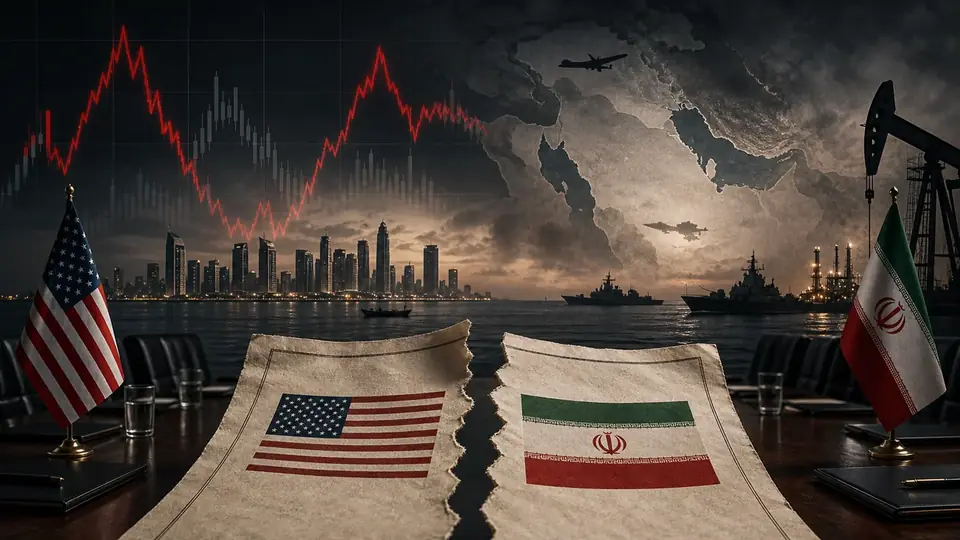
The fragile pause between the United States and Iran appears to be unraveling following a new round of military strikes, raising concerns that both nations may once again be moving toward direct conflict.
Only weeks ago, the two countries announced a Memorandum of Understanding (MOU), a temporary agreement designed to create a 60-day window for negotiations. While not a formal peace treaty, the agreement was intended to provide both sides an opportunity to pursue diplomacy instead of continued military escalation.
Following the latest strikes, however, President Donald Trump stated that he believes the agreement is effectively over, signaling what could be the collapse of the diplomatic process before negotiations reached a lasting resolution.
Questions Emerge About the Collapse of Negotiations
President Trump has argued that Iran failed to negotiate in good faith, accusing the country of dishonesty and suggesting diplomacy had run its course.
The comments raise broader questions about why negotiations appear to have ended after only a few weeks and whether both sides have now abandoned the process intended to prevent a wider regional conflict.
If diplomacy is no longer an option, attention turns to what strategy remains.
Former Intelligence Official Questions Military Approach
Among those questioning the current strategy is former Director of Counter-Intelligence Joe Kent.
In a public statement, Kent argued that the Memorandum of Understanding was negotiated because military action had already proven incapable of resolving the dispute surrounding the Strait of Hormuz.
According to Kent, returning to limited military strikes is unlikely to alter Iran’s strategic position. Instead, he suggested the United States consider stepping back militarily while using sanctions relief as leverage to encourage future negotiations rather than risking a broader conflict through continued exchanges.
His comments underscore a growing debate over whether military operations can resolve what is fundamentally a political and economic dispute.
Strait of Hormuz Remains the Central Issue
While recent headlines have focused on airstrikes, the broader disagreement centers on control of the Strait of Hormuz, one of the world’s most important maritime trade routes.
The United States has long sought to ensure uninterrupted commercial shipping through the waterway in order to stabilize global energy markets and keep oil prices from rising.
Iran, however, views the strait as one of its strongest sources of strategic leverage and has argued that commercial transit should occur under conditions coordinated with Tehran.
According to reports surrounding the Memorandum of Understanding, Iran agreed to use its best efforts to facilitate safe passage through the strait. Iranian officials have also maintained that vessels were expected to coordinate their transit with Iranian authorities.
The United States has instead encouraged commercial shipping to bypass that process, prompting Iranian warnings that ships refusing to coordinate would not be permitted to pass safely.
Shipping and Energy Markets Face Renewed Uncertainty
The disagreement has already begun affecting commercial shipping.
Reports indicate that some vessels have delayed or altered planned routes while insurers have become increasingly cautious about covering transits through the Strait of Hormuz.
Any prolonged disruption could place additional pressure on global oil supplies, potentially driving up fuel prices and contributing to higher inflation worldwide.
For most Americans, those economic effects may ultimately prove more significant than the military exchanges themselves.
Higher energy prices affect transportation costs, consumer goods, and household budgets, making stability in the Strait of Hormuz an issue with consequences well beyond the Middle East.
Strategic Questions Remain
President Trump previously warned that failure to preserve the agreement could carry significant economic consequences, even suggesting continued instability could contribute to a global economic downturn.
At the same time, concerns remain over the size of the U.S. Strategic Petroleum Reserve, which continues to sit well below historical levels after major drawdowns in recent years.
Those factors have prompted critics to question how renewed military action advances Washington’s stated goals of stabilizing energy markets, lowering oil prices, avoiding a wider regional war, and restoring normal shipping operations.
So far, the latest strikes do not appear to have fundamentally changed the strategic balance.
Iran continues to maintain leverage over the Strait of Hormuz, commercial shipping remains cautious, and U.S. military forces remain deployed throughout the region.
NATO Comments Prompt Additional Speculation
President Trump’s remarks declaring the agreement effectively over were made while attending the NATO summit in Ankara rather than from the White House.
That has led some observers to speculate whether the comments were directed solely at Iran or also intended as a message to NATO allies.
Given the administration’s continued emphasis on burden-sharing and increased allied support, some analysts have questioned whether the president was signaling that European partners should be prepared to support U.S. policy toward Iran in the same way Washington has encouraged support for Ukraine.
There is no public confirmation that this was the administration’s intent, but the timing and location of the remarks have prompted discussion.
Diplomatic Path Forward Remains Unclear
As tensions continue to rise, the central questions remain unresolved.
If the Memorandum of Understanding has indeed collapsed, it remains unclear what diplomatic options remain available or whether military pressure alone can alter Iran’s position on the Strait of Hormuz.
With global shipping, energy markets, and regional security all tied to the outcome, the coming weeks may determine whether the current standoff returns to negotiations—or continues down the path toward a broader conflict.